

A buyer’s security review comes back with one open line: send your VPAT. Nobody on the product team has tested the application with a screen reader, the deal has a close date, and a search for the best VPAT providers returns ranked lists. The Information Technology Industry Council (ITI), which publishes the template, states that it does not review, approve or certify the reports written on it.
This guide replaces the ranking with a procedure. It settles how to choose a VPAT provider: who can write the report, what a provider’s method and past reports must show, what the contract should name, and which sales claims end the conversation. A completed VPAT is called an Accessibility Conformance Report, or ACR. The guide to what procurement asks a vendor to provide covers the document itself.
ADA Compliance Pros sells VPAT services itself, which is the reason the guide ranks no one. Every check below can be run against any provider, this firm included.
ITI certifies no VPAT, so vetting VPAT providers falls to the vendor
ITI answers the certification question twice in the FAQ on its VPAT page. On review: “ITI develops and maintains the VPAT template but does not review, approve or certify completed VPATs or ACRs.” On the report itself: “There is no official VPAT or ACR certification, approval or pass/fail rating.” A provider that offers a certified VPAT is selling something the template’s owner says has no official standing. The article on what each accessibility proof attests takes the word certification apart in full.
The same FAQ says who may write the report. “The company that knows the product best, usually the original equipment manufacturer (OEM) or product owner, is generally best positioned to complete it accurately.” A reseller may complete one as well, and ITI “recommends checking with the vendor or OEM first”.
An outside reviewer is a choice until a buyer makes it a condition: “Third-party review is generally optional, although a customer or government agency may require an independent review as part of a procurement or contract.” Read the solicitation or the buyer’s request for that condition before pricing anyone. Inside the vendor, who can fill out a VPAT is a question of roles and is settled separately.
What does exist is a credential held by a person. The Department of Homeland Security certifies individual testers in its Trusted Tester process, and Section508.gov, the General Services Administration’s guidance site, states the consequence: “Agencies that adopt the Trusted Tester Process only accept test results from individuals who have been certified as Trusted Testers.” DHS says its test process “follows the ICT Testing Baseline, which meets the minimum requirements for Revised 508 standards (including WCAG 2.0 Levels A and AA).”
The International Association of Accessibility Professionals issues its own professional certifications, each “Valid for three years”. Its Web Accessibility Specialist credential asks applicants for “a minimum of 3 years of personal experience performing the job tasks”. Each of these credentials attaches to a person. None attaches to a firm or to a report.
Federal guidance on test reports expects the tester to be identified. Section508.gov’s elements of an accessibility test report lists the tester’s name, organization and contact details, and “Tester credentials, if any, to denote subject matter expertise in the area of testing, such as Trusted Tester ID.” That gives the first question for any VPAT consultant or firm, and it can go out by email today: who will test the product, by name, and with which assistive technology?
Three kinds of VPAT providers sell three different things
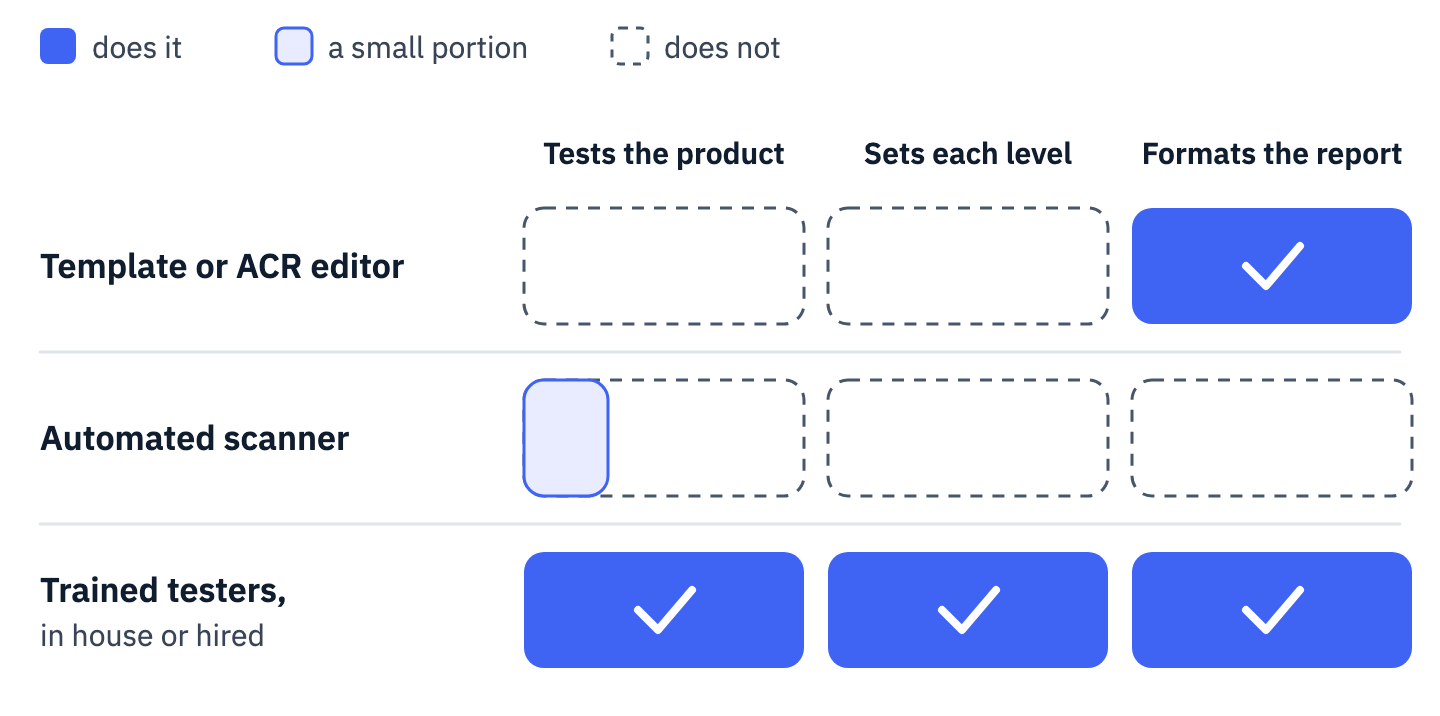
The word provider covers three offers: software that formats a report, a scanner that checks code, and people who test the product. They are not substitutes for each other. Each one does a different part of the work.
VPAT software starts at no cost. ITI’s template is a Word file: “VPAT is free and available to everyone, regardless of ITI membership.” It comes in four editions, and “The latest version, VPAT 2.5Rev, was released in April 2025.”
GSA adds a free web tool, the OpenACR editor, which “helps evaluators build Accessibility Conformance Reports in the OpenACR format” and exports the result as structured data and as a web page. Its own overview says who it is for: “It is designed to help accessibility subject matter experts create machine-readable OpenACR documents.” Software of this kind records answers. Someone else has to produce them.
An automated scanner produces some of them. Section508.gov’s overview of testing methods, last reviewed in May 2018, says of such tools that, once configured to avoid false positives, they “test for only a small portion of the requirements.” Its example is the first success criterion in WCAG: “The ruleset may be able to test if a text alternative is provided, but it may not be able to test if the text alternative is equivalent.”
The same page gives the instruction that follows from the gap: “these Section 508 requirements must be tested manually.” A report whose rows all rest on a scan rests on a small portion of the requirements.
The third offer is people. A VPAT consultant or a testing firm sells VPAT creation services in the full sense: testers work through the product by hand, set a conformance level for each criterion and write the report. Section508.gov puts testing before writing: the product owner or developer “must first test the product against those standards in order to complete an ACR” (how to create an ACR).
| Kind of provider | What it delivers | What stays with the vendor |
|---|---|---|
| VPAT software: ITI’s Word template, GSA’s OpenACR editor | The form, the wording of each row, a file to send | All testing and every conformance level |
| Automated scanner | Pass and fail results for the rules a tool can decide | Manual testing of everything else, the levels, the report |
| VPAT consultant or testing firm | Manual and assistive technology testing, a level and a remark per criterion, the finished ACR | Access to the product, answers about how it works, the fixes |
View the data as a list
- Template or ACR editor: formats the report. It does not test the product and does not set a conformance level.
- Automated scanner: tests a small portion of the requirements. It sets no level and formats no report.
- Trained testers, in house or hired: test the product, set each conformance level and format the report.
If someone in house can test each criterion by hand, with a keyboard and a screen reader, and the buyer has not asked for an independent review, the template or the editor is enough. In every other case the purchase is testing, and software alone leaves the report empty where it matters.
The method section tells you what you are buying
One field of the template carries the evidence. The VPAT 2.5Rev template lists it among the minimum contents of every report: “Evaluation Methods Used – Include a description of evaluation methods used to complete the VPAT for the product under test.” Its best practices list what the answer may hold: testing “with assistive technologies”, testing “with manual and automated testing tools”, and, where a published test method was used, its “name, publisher, URL link”.
Federal buyers are told to ask for that field and then to look behind it. Section508.gov’s guidance on requesting accessibility information has agencies require, next to the ACR, a “Description of evaluation methods used to produce the ACR, to demonstrate due diligence in supporting conformance claims”. It also recommends, as an option and not a requirement, stating that the agency “reserves the right, prior to making an award decision, to perform testing on some or all of the offeror’s proposed ICT items to ensure the accuracy of their response.”
A second page, on reading vendor claims, is blunter: “Whenever possible, purchasers should conduct independent conformance validation testing and evaluation to verify vendor accessibility conformance claims.” GSA’s FY 2025 Governmentwide Section 508 Assessment, built on data the agencies reported about themselves, records what they find: “Agencies report that vendor-provided accessibility conformance reports remain inconsistent or unreliable, increasing the burden on agencies to independently validate conformance.” In the same assessment, 30 percent of agencies said they “almost always” verify contract deliverables for Section 508 conformance. The method paragraph is where a reviewer can start.
One published report, GSA’s ACR for one of its own training courses, shows a usable minimum. Its method field runs to two sentences: “The course was testing using manual and automated tools including assistive technology used by people with disabilities. Tools included Axe, ANDI, JAWS, NVDA, VoiceOver, ZoomText and Dragon Naturally Speaking.” A reader learns from it that the testing was manual as well as automated, that screen readers, a magnifier and speech input were used, and which testing tools supported the work.

The federal guidance on test reports goes further than that field and asks for “the operating system, browser product or version used”, and the test scope, “including what was tested, how many pages, what may have been omitted”.
Before signing, ask each provider for the method paragraph it would write for your product, naming the testers, the manual method, the assistive technology with versions, the browsers and operating systems, the tools, and the screens or flows covered. The draft that comes back is the report in miniature.
A provider’s past reports show its habits before you sign
Ask each provider for an ACR it wrote that the client has already published. Where client agreements keep its reports private, ask the provider to walk through how it fills in the report on a call. Either way, hold the answers to the template’s own minimum contents. The list is short:
- The version line. A current report reads “(Based on VPAT® Version 2.5Rev)”. Section508.gov’s guide still says “Any VPAT® 2.x is acceptable”, so an older line is a question to ask and not a reason to reject.
- Product and date. The template asks for the product “including product version identifier if available” and a report date with, “At a minimum”, the month and year.
- The method field. Present, and specific in the way the previous section describes.
- The terms. “Not Evaluated” has one permitted use: “This can only be used in WCAG Level AAA criteria.”
- The remarks. For a row marked Partially Supports or Does Not Support, the remarks “should identify” the “functions or features with issues” and “How they do not fully support”. Section508.gov calls those remarks “required” in its guide to completing the template.
- The file itself. “The final conformance report must be accessible.”
Exceptions in a report are a good sign. GSA’s ACR for its own course marks one criterion Does Not Support and one Partially Supports, and each carries a remark that says what fails. One of the two names the authoring tool the course was built with.
The federal ACR and VPAT FAQ tells vendors what such rows cost them: “Your product will still be considered for purchase even if all of the Section 508 Technical Standards are not met.” It continues: “Your product will be compared to other similar commercially available products for potential purchase.”
A report in which every row reads Supports and the remarks column is empty shows how the provider will write the next one.
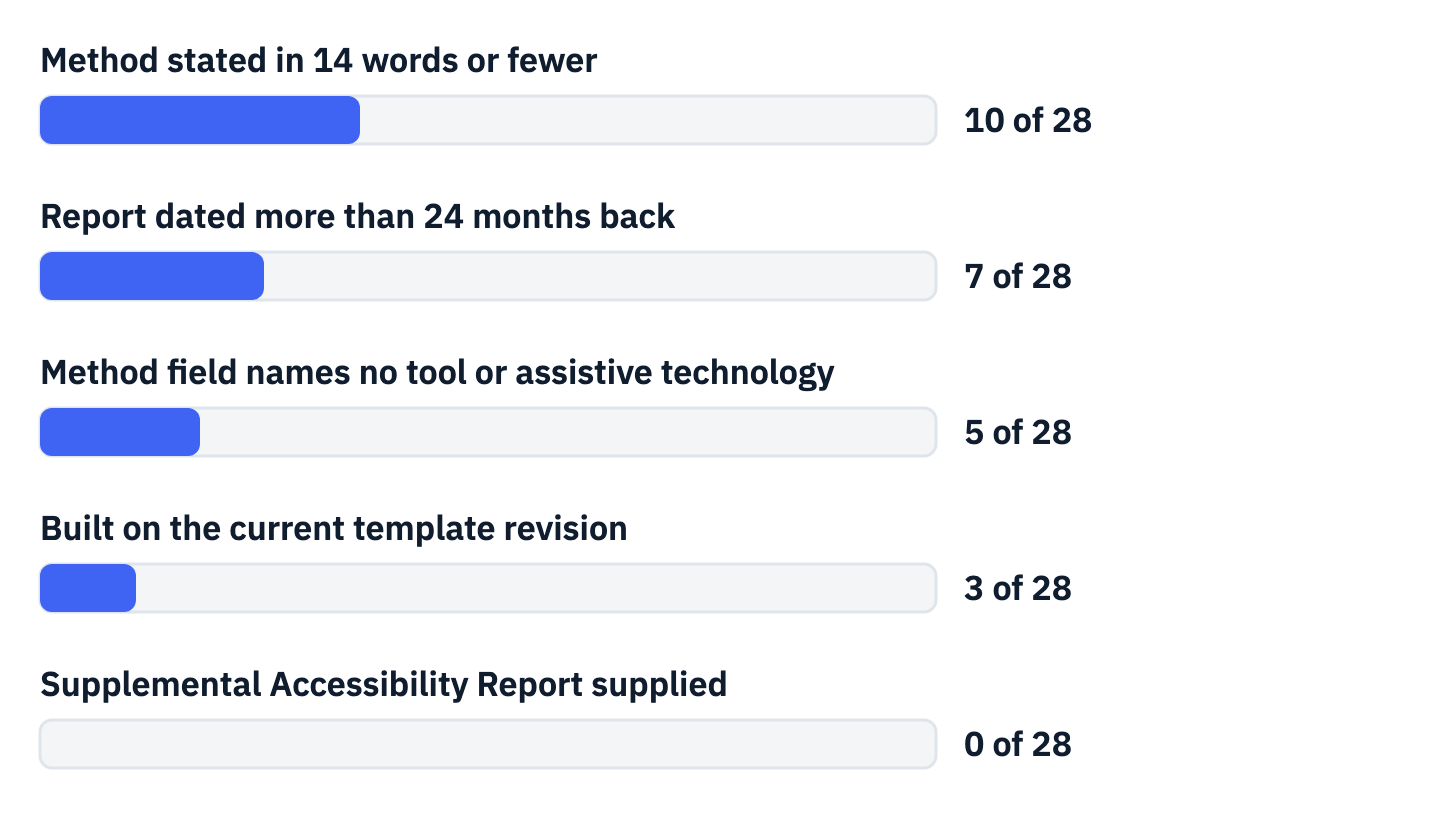
Published reports also give a baseline to read a provider’s work against. A study on this site of 28 published ACRs, all for library and scholarly products and all read on July 27, 2026, scored the documents alone. Ten of the 28 state their test method in 14 words or fewer. Seven carry a report date more than 24 months before the reading.
Five name no specific tool or assistive technology in the method field, three are built on ITI’s current revision of the template, and none supplies the Supplemental Accessibility Report that federal guidance tells agencies to require.
The study itself reads two of those counts as something other than a vendor’s fault: Section508.gov’s guide accepts any 2.x version of the template, and a missing supplemental report points at what the solicitation asked for. The 28 reports come from 18 publishers, and one publisher’s five reports account for half of the short method fields. The counts describe one market, so they work as a method to repeat on a provider’s reports and not as a rate for all software.
View the data as a table
| What the report shows | Reports out of 28 |
|---|---|
| Test method stated in 14 words or fewer | 10 |
| Report dated more than 24 months before the reading | 7 |
| No specific tool or assistive technology named in the method field | 5 |
| Built on the current template revision | 3 |
| Supplemental Accessibility Report supplied | 0 |
Read a report in this order: version line, date, product version, method, the Not Evaluated rows, the remarks on every row that is not Supports, and last the accessibility of the file. A provider whose report passes all seven has shown its habits. The rubric for scoring a vendor’s ACR gives the buyer’s side of the same reading, with weights.
The contract should name the edition, the evidence and the update
The edition comes first, because it follows the buyer and decides which tables the testing has to fill. ITI’s instruction is to “Choose the edition based on the accessibility standards that apply to your product, customer or market”, from a set that covers WCAG, Section 508, the European EN 301 549 standard and an international edition with all three. For federal sales Section508.gov narrows it: “you must use the Revised Section 508 or the INT International Editions of the template”.
A provider that quotes before asking who the buyer is has skipped the first decision. The guide to why clients ask for a VPAT sorts the editions by the buyer who sends the request.
The evidence comes second. An ACR is a summary, and Section508.gov draws the line itself: “An Accessibility Conformance Report (ACR) provides an overview of a product’s conformance to Section 508. In contrast, a Section 508 test report offers a more detailed, developer-oriented document”. Contract for both.
Federal buyers may also ask for a document of GSA’s design: the Issue Detail Supplement “provides additional product details needed by government agencies to better understand the severity and user impact of identified accessibility issues”, including the affected area, the users affected and any workaround. A provider that holds the test data can fill it in. A provider that holds only the report cannot.
The update comes third. ITI’s FAQ says to “Review or update your VPAT and ACR when a product changes in ways that could affect accessibility or when relevant accessibility standards or requirements change”, and the federal FAQ adds that with each change “an updated ACR may be required”. The buyer’s contract can go further. The clause GSA recommends to agencies requires that “ICT must remain accessible throughout the contract period of performance, even as products and software are updated or modified.”
The provider’s contract needs the matching term: a retest and a revised report whenever a release changes how the product behaves for a person using assistive technology. What a statement in the report means once it sits inside a bid is covered in whether a VPAT is a legal document.
| Contract term | What to write | Why |
|---|---|---|
| Edition | The VPAT 2.5Rev edition the named buyer requires | ITI ties the edition to the customer or market; federal sales need the 508 or INT edition |
| Method | Manual testing with named assistive technology, browsers and operating systems, on a listed set of screens or flows | The template’s method field and the federal request for evaluation methods |
| Evidence | The test report behind the ACR, with tester names, the environment, and steps to reproduce each defect | The ACR is an overview; the test report is the detail |
| Supplement | Severity, affected area, affected users and workaround for each reported issue | GSA’s Issue Detail Supplement asks for these |
| Update | A retest and a revised, re-dated report after fixes or a release that affects accessibility | ITI and the federal FAQ both tie the report to the current product |
View the data as a list
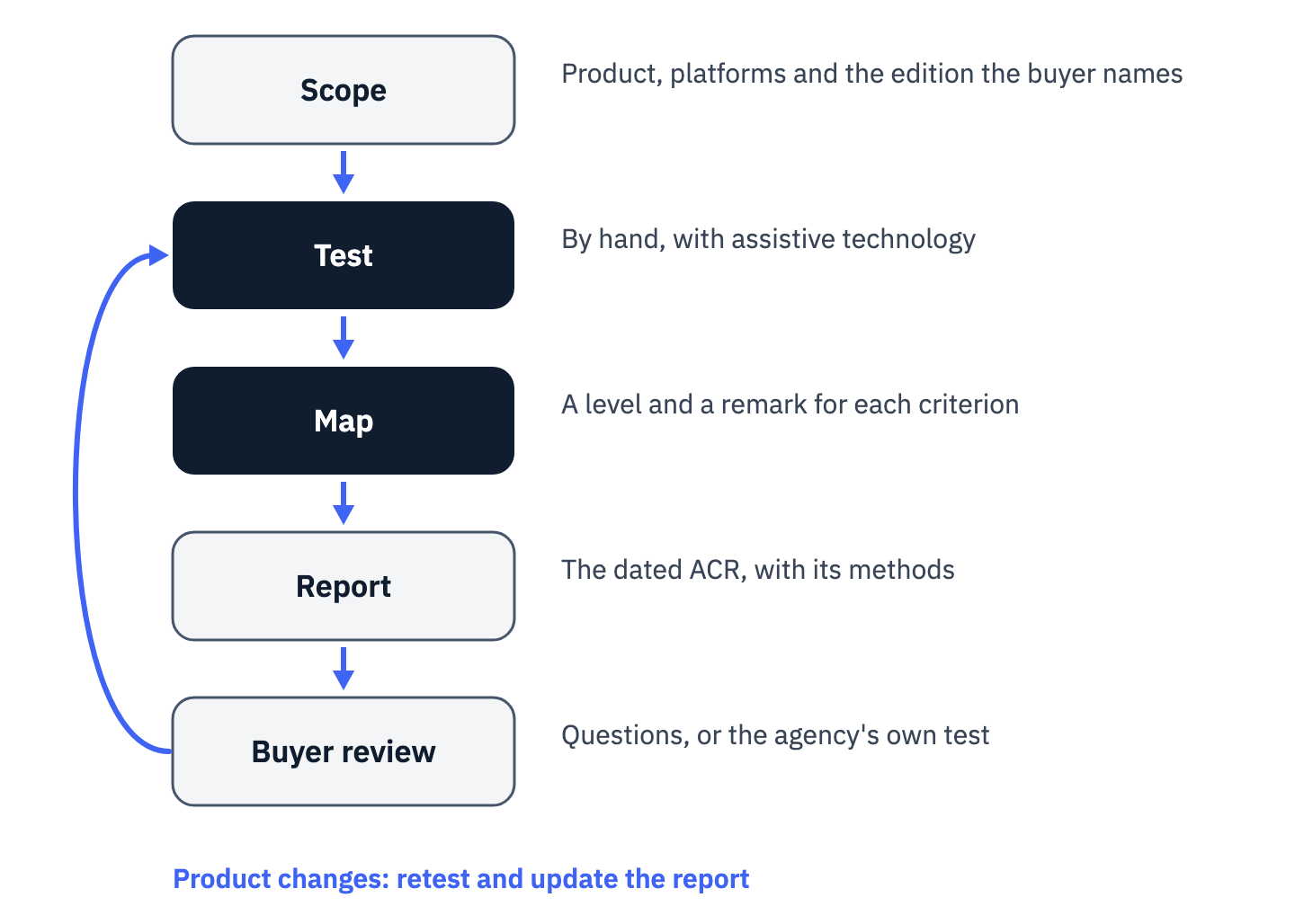
- Scope: the product, its platforms and the edition the buyer names.
- Test: by hand, with assistive technology.
- Map: a conformance level and a remark for each criterion.
- Report: the dated ACR, with its methods.
- Buyer review: questions, or the agency’s own test.
- When the product changes: retest and update the report, starting again at the test step.
Each row of the table can be pasted into a statement of work as a deliverable. A provider that accepts all five in writing has committed to the evidence a federal reviewer is told to ask for. The guide to budgeting for a VPAT covers the cost drivers behind a quote.
Four claims in a proposal are reasons to walk away
A certification. A proposal that offers a certified VPAT or a certified ACR promises what ITI’s FAQ rules out. The rule is to ask which body issues the certificate and to stop when the answer is the provider itself.
Guaranteed compliance from a tool. The Federal Trade Commission has acted on a claim of that kind. Its order against the seller of an automated accessibility product, issued April 21, 2025, bars the company from representing that the product “can make any website compliant with WCAG” unless it holds “competent and reliable evidence”, and states that “Respondents must pay to the Commission $1,000,000.” The Commission announced the final order on April 22, 2025.
It is a consent order that binds the respondents, who neither admitted nor denied the allegations. The article on what an overlay can put in an ACR reads it provision by provision. The rule for a buyer: a compliance promise needs test evidence behind it, and the report will carry the vendor’s name.
A report from a scan alone. A scan covers the small portion of the requirements a tool can decide, and a person has to test the rest. The rule is to ask which criteria a person will test and to decline when the answer is a tool name.
Every row Supports, promised before testing. A provider cannot know the result before the work, and the buyer may check it afterwards: federal guidance recommends that agencies reserve the right to test the product before award. The template puts the outcome on the vendor: “It is the vendor’s responsibility to maintain the integrity of the data in the report.” The rule is that conformance levels come out of testing, and a quote that sets them in advance has priced a document.
Questions buyers ask about VPAT providers
Which companies provide VPAT creation services?
Accessibility consultancies and testing firms that employ manual testers provide them, and so can a vendor’s own team. ITI certifies no completed report, and its VPAT page lists no approved VPAT providers. One directory helps with the people behind a firm: the International Association of Accessibility Professionals invites readers of its certification page to search its directory for “an IAAP-certified individual or organizations that employ IAAP certificants”. A name in a directory starts the vetting. The method paragraph and the provider’s past reports finish it.
What is the best VPAT software for creating the report?
The template itself, in Word, and GSA’s free OpenACR editor cover the writing, and ITI adds “free training and resources to help companies create ACRs and help buyers understand them.” No software tests the product for the author. GSA’s own description of its editor names its user as an accessibility subject matter expert, which is the part of the job a tool does not replace.
Your next step
Three actions come first. Read the buyer’s request for two facts: the edition it names and whether it requires an independent review. Send every provider on the shortlist the same three requests: the names of the testers and the assistive technology they use, the method paragraph it would write for your product, and a published ACR it wrote or a walk-through of its reporting on a call. Then put the five contract terms from the table into the statement of work before anyone signs.
Two things stay outside any provider’s reach. Which standard and edition a buyer accepts is the buyer’s decision, so confirm it with the contracting officer or the procurement contact in writing. What the report’s statements commit the company to inside a bid or a contract is a question for counsel.
ADA Compliance Pros tests the product by hand with assistive technology, including screen readers and keyboard-only use, and completes the ACR in the edition the buyer requires, with a remark that explains each result. The engagement includes a prioritized list of the gaps, direction the vendor’s engineers can act on followed by a retest, and consistent answers to the buyer’s follow-up questions and questionnaires. Scope is settled on one call about who is requesting the documentation and which standard they expect, and it starts with VPAT testing.